


Rhetorical Citizenship and
Democratic Education
in the Baltic Sea Region
6–8 May 2026
Södertörn University, Stockholm
Democracy across the Baltic Sea region faces mounting pressures from polarization, disinformation, and declining civic trust, leaving young people uncertain about meaningful participation and teachers without concrete strategies for schools’ democratic mission. This conference highlights the civic potential of rhetorical education in secondary schooling, focusing on how argument literacy and deliberative agency are cultivated in classrooms, particularly through language instruction. Bringing together researchers and teachers, it offers an interdisciplinary forum to examine how rhetorical competencies are mobilised in policy, curriculum, and practice. The Baltic Sea region provides a crucial context for this dialogue, where differing national approaches invite comparative analysis and mutual learning.
The Conference
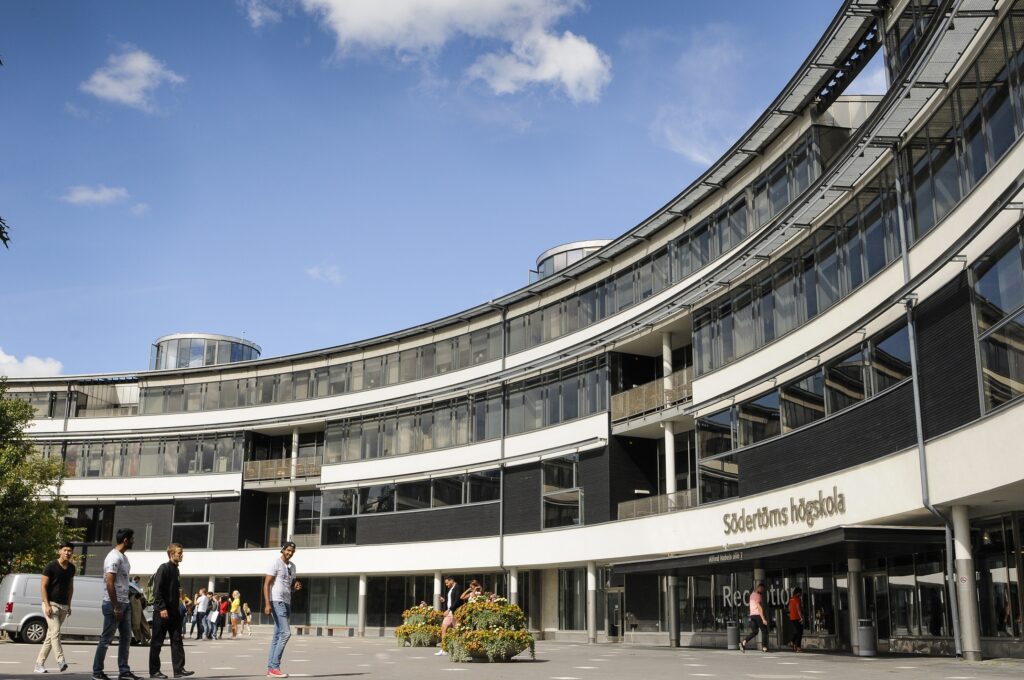
Venue
Södertörn University, Stockholm, Sweden
Getting here:
Take an SL commuter train from Stockholm City towards Södertälje or Tumba (approximately 19 minutes).
Alternatively, take a Mälartåg regional train from Stockholm Central (approximately 10 minutes).
Get off at Flemingsberg station. When you exit the station, turn right. Campus Flemingsberg and Södertörn University are located at the top of the long escalators.
Campus Map
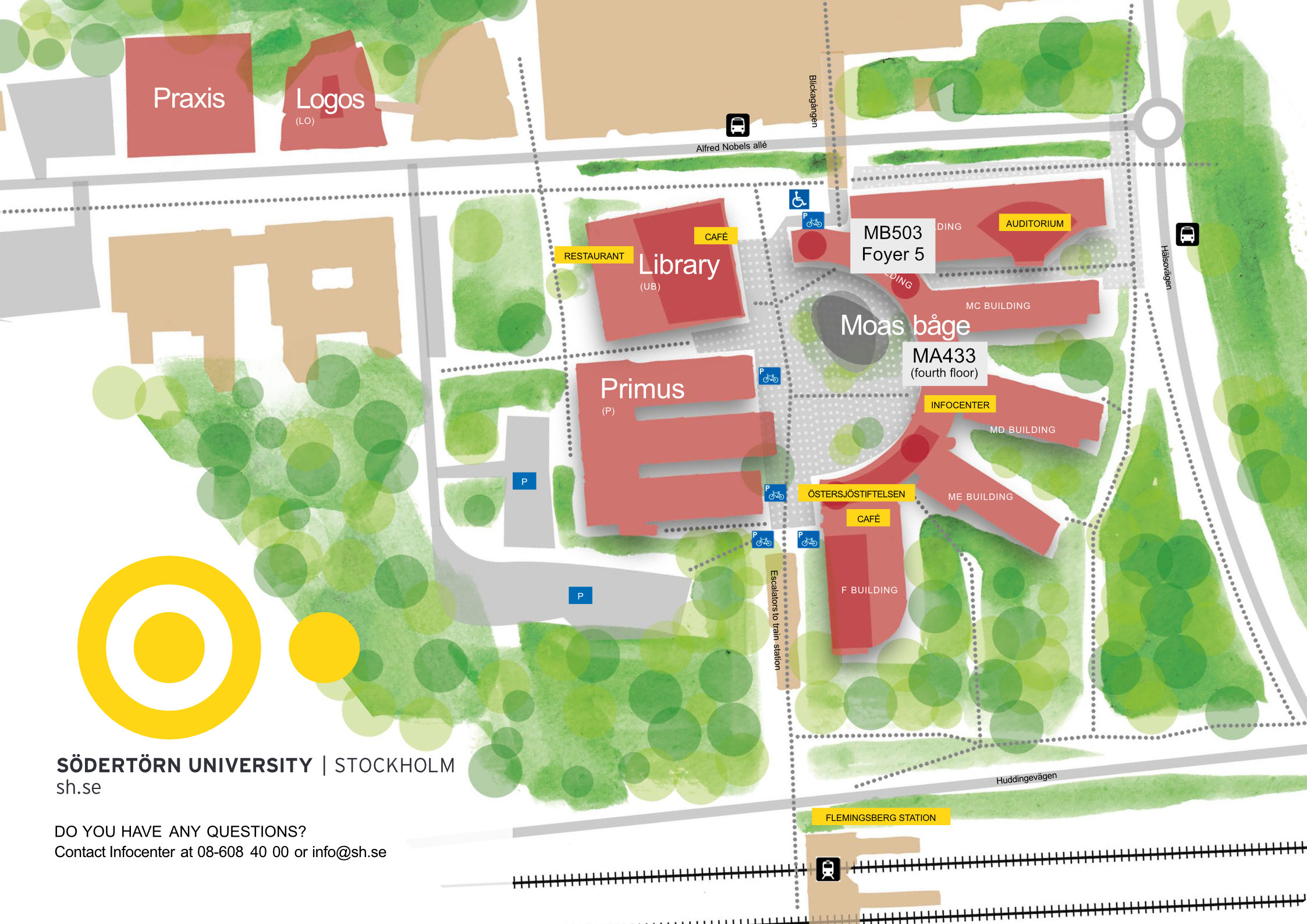
(Click to enlarge)
Programme
Preliminary programme (to be updated):
Wednesday 6 May 2026
11:00–13:00 Registration (Foyer 5)
12:00 Lunch (Foyer 5)
13:00 Opening remarks (MB503 Öland)
13:30 Keynote: Mika Hietanen, ”Rebuilding Public Reason in an AI-Mediated Age” (MB503 Öland)
Democratic argument is not failing for lack of logic. It is failing because the shared ground beneath logic – the premises citizens once held in common – has fractured under information environments engineered for engagement rather than truth. When the same evidence is anchored by incompatible starting points, argument cannot cross; communities harden into fortresses built not from facts, but from what facts are for. Argument literacy remains essential, but no single literacy can outrun a machinery that manufactures plausibility at scale. What democratic citizenship now requires is a meta-literacy: the capacity to surface the premises beneath our claims, to audit the systems that shape what feels true, and to move between competing worldviews without losing our own bearings. This is the work of rhetorical citizenship in an AI-mediated age. Democratic judgement is more crucial than ever, and it is teachable.
14:30 Paper presentations: Session 1 (MA433)
15:30 Coffee break (MA433)
16:00–18:00 Paper presentations: Session 2 (MA433)
Thursday 7 May 2026
09:00 Coffee and informal gathering (MA433)
10:00 Paper presentations: Session 3 (MA433)
12:00 Lunch (Foyer 5)
13:00 Presentation of the DEMORHET/READy research project networks (MB503 Öland)
14:00–16:30 Paper presentations: Session 4 (MA433)
19:00 Conference dinner at Södertörn University (Allé Elva)
Friday 8 May
09:00 Coffee
10:00 Paper Presentations: Session 5 (MA433)
12:00 Lunch (Foyer 5)
13:00–14:00 Next steps, closing remarks, and farewell (MB503 Öland)

Sessions and Abstracts
[Click presentation titles to show abstracts]
Sessions 1 & 2 (Wednesday 6 May 14:30–17:00)
Lihong Huang, Bryony Hoskins & Jens Bruun, ”Fostering democratic citizenship in the Nordic and Baltic countries”
This is a presentation of the editorial introduction to the special issue published at JSSE – Journal of Social Science Education https://www.jsse.org/index.php/jsse/issue/view/512 . As background analysis for the issue, we provide an overview of citizenship education from students, teachers and school leaders’ perspectives across six countries, i.e., Denmark, Estonia, Latvia, Lithuania, Norway and Sweden, using data from the International Civic and Citizenship Education Study (ICCS, 2009, 2016, 2022). The overview is structured by results from analyses of three types of participants: 1) from student data, we present trends of civic knowledge achievement and expected political participation; 2) from school principal /leader data, we present trends of the most important aims of citizenship education and school autonomy in citizenship education on issues such as curriculum planning, choice of textbooks and teaching materials; and 3) from teacher data, we present trends of learning assessment methods and teaching methods often used by citizenship education teachers.
Karel Haav, ”Which civic and rhetorical concepts are vital in politics and education?”
The paper will explore some rhetorical concepts and ideas for teaching of some of the power conflicts in Estonia’s recent history. The cases will be analysed using dichotomic concepts of social actors and structures. In democratic countries, there are four main social groups (politicians, civil servants and administrators, and ordinary citizens) with unequal opportunities to use social structures and influence other citizens. According to authoritarian and functionalist ideology, authorities neither make mistakes nor misuse their power. According to the pluralist research paradigm, violations of democratic norms sometimes occur. The authoritarian ideology facilitates these cases of violation. The pluralist paradigm reveals the arbitrariness of decision-makers and takes action to protect democracy. Both active citizens and critical scholars need to improve their political and rhetorical knowledge, attitudes and skills. The paper will find out some rhetorical concepts and methods for that (R. Knight 2025, A. Holmes-Henderson 2022). These concepts will be used to analyse of some power conflicts. Some scholars criticized the Estonia’s authoritarian and corporate government in 2001 („Two Estonias“) and 2012 (Charter 12). In 2023, a small rural educational community (Metsküla school) resisted the arbitrariness of local authorities in county Lääneranna. The Paper explains why the two academic projects were inadequate and had little effect on democratic development. The school case will be successful as a result of the 2025 elections of new local authorities.
Christina Matthiesen, ”The Case of Rhetoric as an Elective Course in Upper-Secondary School”
As a distinctive opportunity, students in Denmark and Sweden in university preparatory programmes at public upper-secondary schools are presented with rhetoric as an elective course. In this study, I examine and compare the current national rhetoric curricula in public upper-secondary school in Denmark and Sweden. I display and discuss their relationship with the framework of rhetorical citizenship and the classical rhetorical educational tradition. Through a content analysis, I focus on the curricula’s representation of productive and receptive dimensions of rhetorical citizenship (Kock & Villadsen, 2014) and the categories of rhetoric as a course study presented by David Fleming: technical, anthropological, and paideutic rhetoric (1998, Hogarth et al., 2021). Thus, this cross-cultural study contributes with empirical knowledge to the ongoing conversation in our field regarding the educational foundations and potential of rhetoric in relation to civic education (Biesta, 2012; Brummett, 2012; Graff, Walzer & Atwill, 2005; Hauser, 2004; Rutten & Soetaert, 2012; Terrill, 2011). By examining current national rhetoric curricula, as opposed to textbooks, actual teaching practices, or extracurricular initiatives, I highlight a formally regulated educational context that not only involves a majority of a youth population but reflects dominant understandings of rhetoric. Thus, this cross-cultural study both clarifies and contests dominant understandings of rhetoric, moulding the ground for a richer and more nuanced understanding of rhetoric and the cultivation of rhetorical citizenship in schools.
Session 3 (Thursday 7 May 10:00–12:00)
Anette Mansikka-aho, ”A Foucauldian Analysis on the Potentials of Intergenerational Climate Conversations”
Young people today are exposed to information about climate change and other environmental crises from an early age, and many of them feel threatened by how those crises impact their own future. To convince older generations of the importance of solving climate change-related questions, many young people are engaged in discussions about environmental crises. These conversations, however, are often marked by polarization and disinformation, particularly within homes where school-acquired knowledge may conflict with familial values, practices, or beliefs.
Political discussions within families are critical learning spaces for young people to practice rhetorical and deliberative competencies fostered at school. Yet, the power dynamics inherent in family structures can constrain young people’s willingness and ability to participate in these dialogues. In such conversations, many young people are challenging traditional pedagogical relations with older generations by forming what we call reverse pedagogical relations. In reverse pedagogical relations, young people destabilise traditional positions in pedagogical relations, in which older people typically act as educators, by educating older people.
The presentation explores how young people identify, submit to or reverse traditional pedagogical relations through six focus group discussions. Since the discourse of young people emphasizes the relationship between knowledge and power, the data were analysed using Foucauldian discourse analysis. These findings provide important insights to how young people identify limits and potentials to reversing existing power and knowledge relationships in education. The presentation asks what kind of implications this might have young people’s ability to have intergenerational political conversations.
After the presentation, we will have time to reflect together on how the results presented should contribute to the teaching of rhetorical competences. What kinds of skills do young people need when encountering complex power dynamics, especially when education has strengthened their rhetorical and epistemic competencies to engage in political discussions?
Lisa Källström, ”Rhetorical Citizenship: Cultivating Democratic Engagement through Memes and Interpretive Practice”
A dog sits calmly in a burning room, saying, “This is fine.” Humorous at first glance, K.C. Green’s meme opens a space to examine interpretation, ethical responsibility, and civic engagement. In contemporary pluralistic societies, democratic education is inherently rhetorical. It requires more than teaching facts or argumentation; it demands cultivating conditions where divergent perspectives and expressive modalities can interact without reducing difference to uniformity. Democracy involves attentiveness, interpretive generosity, and responsiveness. From this perspective, rhetorical citizenship is enacted through practice rather than transmitted as propositional knowledge. Rice and Althouse (2019) emphasize that it encompasses active engagement and ethical responsibility, while Rosenfeld (2017) highlights reflexivity and responsiveness in classroom interactions as micro-practices of democracy, echoing Dewey’s (1916) argument that education fosters participatory competence. Mouffe (2000) underscores that pluralism and conflict are essential to democratic practice, and Felton, Middaugh, and Fan (2024) show how digital literacy and epistemic cognition support responsible civic action.
Drawing on Mellan ord och bild: Tolkningens retoriska vägar [Between Word and Image: The Rhetorical Paths of Interpretation, Hellspong & Källström 2025], I identify four interdependent qualities central to democratic dialogue: responsiveness, reflexivity, openness, and multiplicity of perspective. These qualities provide analytic and pedagogical guidance for cultivating students’ capacities for deliberation, ethical judgment, and interpretive engagement. Classroom practices, including exercises with memes, enact these qualities, as shown by Cho, Cho, and Kim (2022) and Holmes-Henderson, Žmavc, and Kaldahl (2022). Rutten and Soetaert (2013) stress that rhetorical competence is inseparable from civic literacy, and empirical studies by Samuelsson and Bøyum (2015) and Enslin, Pendlebury, and Tjiattas (2001) demonstrate how deliberative practices enhance civic participation.
By engaging students as active interpreters of culturally circulated texts such as memes, classrooms become sites where ethical reflection, critical reasoning, and responsiveness to difference are practiced. Contested memes, such as This is fine, illustrate the co-constructed and context-dependent nature of interpretation and the ethical stakes of digital participation. Approaching pluralism as both principle and practice, rhetorical competence becomes a form of civic literacy: the ability to respond and act in ways that sustain mutual recognition and democratic engagement.
Sonja Helkala, ”Political emotions in democratic education in Finnish schools”
When we gather at school, discuss social and political issues, form political identities, and strive to raise critical and active citizens, we inevitably encounter political emotions. Emotions, passions, and conflicts are an integral part of interaction between people and communities in a democratic society, and political issues can also be highly emotional in the classroom. That is why it is important to examine democratic education specifically from the perspective of political emotions.
This presentation is based on my doctoral thesis, in which I explore democratic education in Finnish schools from the perspective of political emotions and classroom discussions. I ask how political emotions manifest in schools and what meanings are given to them in the context of democratic education. The data consists of ethnographic observations and interviews of teachers and students produced in Finnish schools in secondary and upper secondary education.
The results of my research show how political and collective identities are constructed in schools through political emotions, and this process is intertwined with the social interaction and social norms of the group. Today, however, the emotional cultures of digital and social media are also seeping into classrooms, influencing how political emotions are experienced and expressed in school. The results also show how it is often difficult to stimulate discussion on political issues in schools, and teachers would like to see more emotion and passion in their lessons. At the same time, however, certain dimensions of political emotions cause challenges for teachers, who struggle to balance their role as educators with the personal nature of emotions in the semi-public space of the school.
Christoffer Wärn, ”Demokrati i finländska gymnasier under 2000-talet – Synen på demokratifostran, delaktighet och retorik i den finländska gymnasieutbildningens läroplan”
Syftet med den finländska gymnasieutbildningen är att ge en allmänbildande undervisning som förbereder ungdomar på fortsatta studier och det samhälle som väntar dem. Detta samhälle präglas alltmer av polarisering, risk för desinformation och ett allt större behov av att ha tillräckliga färdigheter för att kunna delta i samhällsdebatten. I de nationella grunderna för gymnasiets läroplan (GLP), utgivna av Utbildningsstyrelsen, framkommer också denna tanke i olika avsnitt, såväl i beskrivning av gymnasieutbildningens mål som i beskrivning av innehållet i läroämnet modersmål och litteratur.
Med detta som bakgrund vill jag göra nedslag i de tre finländska gymnasieläroplaner som har varit gällande under 2000-talet: GLP2003 som togs i bruk 2005, GLP2015 som togs i bruk 2016, och GLP2019 som togs i bruk 2021 och är den gällande läroplanen idag. Syftet är att presentera hur demokratifostran, delaktighet och retorik behandlas i de styrdokument som har genomsyrat undervisningen i finländska gymnasier sedan 2000-talets början. En jämförelse av valda delar av läroplanernas allmänna avsnitt samt av innehållet i läroämnet modersmål och litteratur erbjuder en överblick över synen på dessa fenomen, såväl i allmänhet som i ett av de läroämnen vars uppgift är att undervisa i nödvändiga färdigheter för att uppnå målet med gymnasieutbildningen. Genom att jämföra läroämnets uppbyggnad och förändring sedan 2000-talets början uppstår också intressanta frågeställningar: Hurdan utveckling har skett, och svarar ämnesinnehållet på samhällets krav?
This session includes online participation by some presenters.
Session 4 (Thursday 7 May 14:00–16:30)
- Abigail Gometz & Karl Peterson, ”Teaching Democracy through Totalitarianism: An Experiential, Intercultural Approach”
Joanna Nowakowska, ”From Alarm to Affirmation: Toward a Language of Ecological Care”
In recent decades, ecological communication has often adopted a tone of alarm and moral urgency. Metaphors of crisis and combat – fight, battle, or war on climate change – have shaped much of the public conversation, seeking to provoke action but frequently risking fatigue, polarization, or guilt. At the same time, a growing number of scholars and practitioners suggest that rhetorical strategies grounded in affirmation, humor, and shared joy may be more conducive to empathy and collaboration. Such strategies have already been employed by marketing specialists working for companies closely aligned with environmental causes. Rather than confronting audiences with threats, this discourse invites them to imagine themselves as participants in a shared effort of care.
This paper considers how a more positive ecological rhetoric might contribute to rhetorical citizenship, understood as the capacity to engage others in deliberation and collective responsibility. Drawing on ecophilosophical perspectives from Arne Naess, Félix Guattari, and Henryk Skolimowski – all of whom emphasized that ecological transformation must emerge from communal action – the study explores how rhetorical gestures of connection and gratitude can open space for civic cooperation.
By examining selected examples from ecological campaigns and public discourse, the paper seeks to trace a movement from alarm to affirmation. It asks how linguistic inclusiveness, humor, and a vocabulary of care might foster democratic participation and a renewed sense of belonging. Rather than arguing for a full replacement of critical or urgent tones, the aim is to suggest that the language of affirmation could complement them, allowing environmental communication to cultivate not only awareness of danger but also confidence in our shared capacity to act.
Pille Raudla-Loode, ”Creative Work as a Developer of Thinking and Self-Expression at Audru School”
This article presents the practice-based experience of Audru School in implementing a structured creative project course as an integral component of basic education. Following the 2011 National Curriculum for Basic Schools, the creative research project has been established as a compulsory requirement for completing lower secondary education and must be undertaken during Stage III (Grades 7–9). The project integrates knowledge from different subject fields, general competencies developed throughout the entire educational process, and subject-specific skills. At Audru School, the creative project is completed in Grade 8.
At Audru School, the creative research project, carried out by all 8th grade students, is designed not merely as a formal requirement, but as a pedagogical tool that fosters independent thinking, self-expression, and a sense of personal responsibility. Emphasis is placed on the entire process, from topic selection and goal setting to research, execution, presentation, and reflection, rather than solely on the final product.
A key feature of the Audru School model is the systematic integration of creative work with computer studies. Students are taught how to search for relevant and reliable information, critically evaluate sources, cite correctly, and format their work to meet both academic and linguistic standards. This interdisciplinary approach supports the development of digital competence alongside research, rhetorical, and communication skills
Throughout the process, teachers act as mentors, providing individual guidance and sustained feedback. Assessment focuses not only on outcomes but on supporting each student’s cognitive and reflective development. Reflection is conceived as a multi-layered, dialogical practice that extends beyond formal evaluation: through structured feedback discussions with supervisors and an assessment committee, students engage in reasoned argumentation, learn to justify their choices, respond to challenging questions, and evaluate their own reasoning critically.
The project topics often reflect students’ personal interests while addressing socially relevant themes such as mental health, digital behavior, environmental awareness, or language use. This value-based orientation helps students recognize the societal impact of their words and actions, strengthening their capacity to participate thoughtfully in democratic dialogue
Audru School’s experience demonstrates that when creative projects are embedded in a supportive and interdisciplinary learning environment, they serve as effective tools for developing not only academic skills but also rhetorical agency, social awareness, critical thinking, and active citizenship.
Claire Hogarth, ”Bridging School and Civic Life Through the Problem-Solving Proposal”
A challenge in teaching rhetoric at the secondary level is that students struggle to adapt their writing to an audience. As a result, their rhetorical choices remain generic—arguments delivered to no one in particular. Proposal writing directly addresses this problem because it requires students to write for a decision-maker and to tailor their reasoning to that audience’s responsibilities, values, and constraints. When students learn to frame an idea in terms of what a municipal committee can act on, or how a school leadership team evaluates resource allocation, they are practicing genuine audience analysis. In this way, proposal writing helps students apply abstract rhetorical principles to civic contexts that give those principles purpose. This paper describes a proposal-making task used in a post-secondary course in Civic Communication (a presentation with visual aids), along with illustrative samples of student work. Drawing on major textbooks on rhetorical writing, it recommends instructional strategies relevant for secondary teaching, such as invention heuristics for audience analysis and templates for generating reasons and justifying solutions. Together, these strategies help make proposal writing a meaningful way to teach rhetoric as civic practice in secondary education.
Session 5 (Friday 8 May 10:00–12:00)
Shane Crombie, ”Rhetoric and Social Change: Advancing Democratic Competencies from Secondary to Higher Education”
This proposal introduces a renewed university-level course, Rhetoric and Social Change, currently offered at LCC International University in Klaipėda, Lithuania. The course is modelled on the pragmatic rhetoric of Hrabanus Maurus, Hugh of St Victor, and John of Salisbury, and functions as a direct continuation and deepening of the rhetorical and deliberative competencies fostered in secondary education. While the conference addresses the challenge of equipping schools to fulfil their democratic mission, this contribution focuses on the formative period of young adult leadership—the transition to higher education. By showcasing these advanced strategies, the presentation demonstrates how higher education can inform and inspire the pre-university curriculum.
The course moves beyond foundational skills to equip students with critical frameworks necessary for navigating high-stakes democratic challenges, such as polarization and disinformation. It specifically adapts insights from these medieval rhetorical traditions to analyse modern phenomena, beginning by establishing an ethical rhetorical framework (Maurus). By investigating the rhetoric of structure and knowledge (Hugh), students will be encouraged to critically examine the educational, political, and cultural worlds they are part of. They will not only learn to engage in public discourse; they will learn how to be ethical citizens in the formation of democratic and values-based systems. Finally, by introducing the rhetoric of action (John) and exploring how those with power use rhetoric to form public opinion, students will understand that rhetoric is not just a debating skill, but has the power to effect change. The course’s structure provides a concrete, enhanced strategy to actively support the civic potential of rhetorical instruction initiated in the formative school years.
By synthesizing the ethical, cognitive, and practical dimensions of the medieval approaches, the course presents rhetorical models as effective critical tools. Students will have the opportunity for a more impactful experience of navigating their communicative world. This course is a tool for cultivating the deliberative agency and media literacy required to strengthen democratic resilience in the Baltic Sea region.
Stefan Rimm, ”From Apathy to Agency: Moral Imitation and Political Exemplarity in Upper-Secondary Education”
This paper revisits the classical rhetorical concepts of imitatio and aemulatio and their potential as moral and civic practices in contemporary upper-secondary education. Moving beyond stylistic imitation, it treats moral exempla as resources through which students learn to recognise, assess, and potentially enact forms of rhetorical, political, and ethical action.
Situated in Sweden and oriented towards the Baltic Sea region as a comparative horizon, the paper addresses a central democratic problem today: whether schooling cultivates political agency or political apathy.
Empirically, the project proposes a rhetorical analysis of textbooks, teacher guides, and associated digital resources used in upper-secondary courses in Swedish and Civics. It maps the repertoires of exemplarity these materials make available, including figures drawn from history, contemporary public life, and popular culture. Particular attention is paid to exemplars linked to democracy and fundamental human rights, and to the rhetorical framing through which they become pedagogically usable: as civic models, as bearers of exemplary acts, or as individuals attributed with exceptional moral stature.
Drawing on rhetorical curriculum theory, dramatistic rhetoric, and research on rhetorical agency, the analysis asks what arenas of participation are presupposed, what counts as an exemplary act, and what means of influence students are invited to recognise. Comparing the two school subjects, it explores shared patterns and subject-specific distributions of agency-promoting exemplarity.
It also examines the student positions implied in the emerging motives: whether they encourage students to imagine themselves as capable of political action, or whether they risk positioning students as spectators, fostering admiration without participation or even leading to political apathy in a public narrative where futility is normalised.
The paper concludes by arguing for a pedagogy of moral imitatio in which exemplarity itself becomes an object of rhetorical inquiry and a resource for democratic formation.
- Concluding Discussion
Organising Committee
Dr Stefan Rimm, conference chair
Senior Lecturer in Rhetoric, Södertörn University
stefan.rimm@sh.se
https://www.sh.se/kontakt/forskare/stefan-rimm
Associate Professor Mika Hietanen
Senior Lecturer in Rhetoric, Lund University
mika.hietanen@kom.lu.se
https://portal.research.lu.se/sv/persons/mika-hietanen